Path of Exile 2 Unique Item Reworks: Builds to Watch on the Road to 1.0
A pair of boots that turns a landing into a lightning explosion. Gloves that let Cold Damage contribute to Ignite. A helmet that gives Light Radius a direct connection to damage. The Path of Exile 2 Unique item reworks introduce new reasons to reconsider equipment that previously had limited appeal.
These changes reward players who build around a specific interaction. Several items gain dedicated skills, while others exchange familiar bonuses for more specialized effects. The details below cover previewed designs; individual rolls should not be treated as complete modifier ranges or guaranteed launch values.
Elemental Uniques That Change How Damage Works
Blueflame Bracers: Cold Hits With Ignite Potential
Blueflame Bracers retain their defining modifier: 100% of Fire Damage Converted to Cold Damage. Their reworked design adds a second interaction that makes this conversion much more interesting: Cold Damage from Hits also Contributes to Flammability and Ignite Magnitudes. The preview also introduces Frostflame and increased Armour and Energy Shield.
That combination creates a clear direction for experimentation. A character can convert Fire Damage into Cold Damage while retaining a route into Ignite through the gloves’ explicit modifier.
The distinction matters when planning damage scaling. Conversion and permission to contribute to Ignite are separate mechanics. The gloves connect them, but they do not establish that every Cold Damage bonus automatically improves every part of the resulting build.
For an early test, choose one compatible skill and compare its hit damage, Ignite performance, and defensive requirements before committing the entire passive tree.
Radiant Grief: Light Radius Becomes an Offensive Stat
Radiant Grief takes an unusual equipment stat and gives it a direct offensive purpose. Its preview grants Radiance and makes increases and reductions to Light Radius also apply to Ignite Magnitude. Maximum Life joins the helmet’s existing defensive theme.
This makes Light Radius worth evaluating alongside conventional Ignite investment. The strongest setup will depend on how efficiently a character obtains the stat and how Radiance performs against tougher enemies.
An automatic burning playstyle is an attractive possibility, but treating Radiance as interchangeable with Righteous Fire goes beyond the established details. Evaluate its application method, damage, and coverage on their own terms.
Xoph’s Blood: A Fire Build Amulet With Defensive Appeal
Xoph’s Blood combines increased maximum Life, substantial Fire Resistance, and a penalty to the Fire Resistance of enemies in your Presence. The relevant resistance penalty is -25%, rather than the much larger figure sometimes associated with discussion of the item.
Its proposed rework adds Avatar of Fire and an incoming-damage interaction involving Fire Damage. That direction makes it a natural candidate for characters already investing heavily in fire defenses.
For a Smith of Kitava build, the useful question is how the amulet fits the complete defensive setup. Assess the damage taken modifier, resistance investment, and recovery together. Avatar of Fire also deserves a compatibility check before equipping the item, especially when several damage types contribute to the character’s output.
Trigger Uniques That Reshape the Combat Loop
Thunderstep: Turn Jump Attacks Into Lightning Impacts
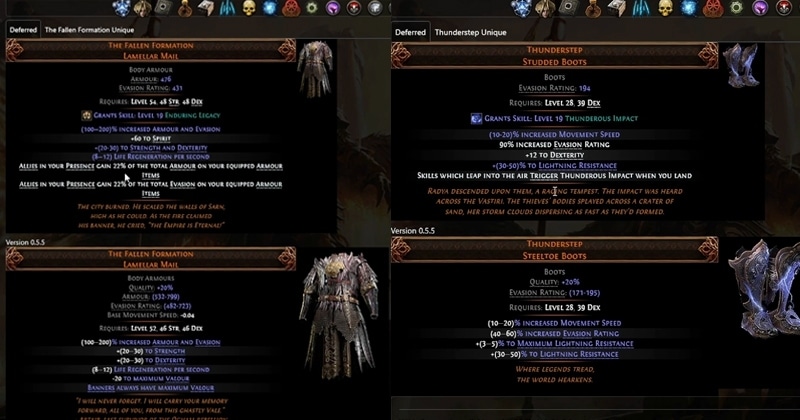
Thunderstep introduces a direct trigger condition: skills which leap into the air trigger Thunderous Impact when you land. The triggered attack deals damage independently of the equipped weapon and leaves Shocked Ground. Its displayed skill details also reward recent Sprinting with two additional Aftershocks and more Area of Effect.
The proposed rhythm is easy to understand: Sprint into position, leap into a pack, land with the additional impact, then move toward the next group.
For build testing, start with trigger compatibility. Establish which leap skills activate Thunderous Impact, then measure how much damage the triggered attack contributes. Its damage model deserves particular attention because a stronger weapon alone does not explain its output.
The interaction offers an appealing foundation for mobile melee builds, provided the movement sequence remains comfortable during sustained boss encounters.
Keelhaul: Flask Use Triggers Geyser
Keelhaul moves from flask support toward a more specialized identity. Its preview grants Geyser and triggers that skill when the character uses a Flask. Increased passive flask charge generation accompanies substantial reductions to Life and Mana Flask recovery rates.
Geyser adds an offensive reason to use flasks, but the recovery penalties create a real equipment decision. A build needs enough sustain to tolerate slower recovery while keeping flask use available.
Any proposed automation interaction needs testing against the exact trigger condition. A flask effect remaining active does not, by itself, establish repeated flask-use events. Confirm that interaction before designing an entire damage loop around it.
Beetlebite: A New Role for a Bleeding Unique
Beetlebite receives Beetle Swarm, added Physical Damage to Attacks, and a chance to Knock Back Bleeding enemies with Hits. It retains the ability to Aggravate Bleeding when enemies enter your Presence. The preview also shifts it onto a lower-level base requiring level 16.
Beetle Swarm supplies the item’s most distinctive new direction: summoned beetles rush enemies and explode, with nearby corpses supporting additional beetle generation and explosions contributing Armour Break.
That suggests two separate testing priorities. During campaign progression, assess whether the added attack damage and Bleeding interaction justify the boot slot. For a dedicated beetle build, investigate corpse availability, explosion scaling, and performance in encounters with few additional enemies.
A lower equipment requirement makes the item easier to equip early. Acquisition remains a separate consideration.
Support and Companion Equipment With New Trade-Offs
The Fallen Formation: Persistent Banners and Shared Defenses
The Fallen Formation’s revised design introduces Enduring Legacy, alongside Spirit and a defensive benefit for allies in your Presence. The preview shows allies gaining a portion of the Armour and Evasion supplied by the wearer’s equipped Armour Items.
Enduring Legacy’s banner interaction is the central attraction: socketed Banner skill auras operate around the wearer without the usual placement step. This points toward a character or companion setup that supplies ongoing support while staying close to allies.
The equipment-sharing modifier needs careful reading. Its stated basis is defensive values on equipped Armour Items. Do not assume it shares the wearer’s entire final defensive total after every other calculation.
For a Squire setup, the practical test is whether the companion can equip the required items, maintain the relevant skills, and remain close enough to deliver the intended benefits.
Alpha’s Howl: Less Spirit, a Werewolf Pack
Alpha’s Howl changes its resource budget in exchange for a more specialized companion theme. The preview grants Werewolf Pack, adds Packleader, and provides 60 Spirit, compared with the existing version’s 100 Spirit. Its doubled Presence Radius remains part of the design.
Losing 40 Spirit affects the rest of a build. Before replacing the helmet, recalculate reservations and identify which persistent skills still fit.
The wolves then need to justify that opportunity cost through their actual contribution. Test their survival, damage, and support behavior in the content the character is intended to farm. Their presence alone does not establish a specific amount of damage protection.
Uniques for Warcries, Recovery, and Strong Enemy Encounters
Redblade Banner: Meet the Power Requirement
Redblade Banner’s preview grants Redblade Ferocity for eight seconds when your Warcry counts at least 20 Power. Enemies in your Presence have double Power, helping the shield support that condition.
This is a threshold-based interaction. It does not mean every Warcry automatically counts as having at least 20 Power.
For a Warcry build, consistency is the main question. Check activation against ordinary packs, isolated Rare enemies, and bosses. A bonus that fits naturally into the existing skill rotation is easier to use than one requiring frequent repositioning.
The displayed 21% increased Block chance also requires precise interpretation. Increased Block chance is not the same wording as adding 21 percentage points to the character’s final Block chance.
Deathblow: Culling Strike Gains a Kill-Based Mechanic
Deathblow keeps Culling Strike and adds one Reaper’s Touch per Power of slain Rare or Unique enemies. Attack Speed and Life and Mana gained on kill remain visible in the preview.
The new modifier creates a reason to assess the gloves across a sequence of encounters. A build that regularly defeats Rare enemies has a different opportunity to use the mechanic from one entering a single isolated boss fight.
Before investing, establish what Reaper’s Touch provides, how long it lasts, and whether the character maintains it during the content that matters. The acquisition condition alone is insufficient to rank the gloves against a strong Rare alternative.
The Everlasting Gaze: Recovery Meets a Granted Skill
The Everlasting Gaze gains Blessing of Lunaris, Life Regeneration, and Zealot’s Oath in its previewed design. Mana and the modifier granting a portion of maximum Mana as extra maximum Energy Shield remain part of its identity.
This gives the amulet several connected areas to evaluate: resource investment, recovery, and the contribution of its granted skill.
A useful comparison is a Rare amulet offering relevant skill levels and defensive modifiers. Measure sustained damage and recovery across a full encounter. A distinctive granted skill earns its slot through its contribution to that encounter, alongside the amulet’s passive stats.
Campaign Uniques With More Immediate Uses
Apron of Emiran: Bleeding Support and Guillotine
Apron of Emiran adds Guillotine, maximum Life, and stronger Evasion and Energy Shield investment while retaining Bleeding you inflict is Aggravated.
That package gives an early Bleeding character several benefits in one slot. The next step is to establish whether Guillotine fits the character’s weapon and skill setup, then compare its boss performance with the skills already available.
A campaign Unique earns its place by improving progression at the moment it becomes available. Long-term endgame relevance is a separate test.
Edyrn’s Tusks: Sprinting and Spirit of the Boar
Edyrn’s Tusks retains its level 11 requirement in the preview and introduces Cannot be Heavy Stunned while Sprinting together with Possessed by Spirit of the Boar. Armour and Physical Thorns Damage remain part of the item.
The Heavy Stun protection gives the body armour a specific movement benefit. Its wording applies while Sprinting, so evaluate it within that condition.
Spirit of the Boar needs a complete mechanical assessment before the item receives an endgame recommendation. Check the effect’s benefits, restrictions, and scaling before dedicating additional equipment slots to support it.
How to Budget for Reworked PoE 2 Uniques
Choose a single interaction to validate before buying a complete equipment set. For Blueflame Bracers, that means confirming the intended Ignite behavior. For Thunderstep, it means checking leap compatibility and triggered damage. For Keelhaul, it means establishing a sustainable flask cycle.
For players comparing offers under the search phrase buy Path of Exile 2 Currency, the useful preparation is a defined equipment budget: the central Unique, supporting gear, and enough flexibility to replace an interaction that fails testing.
A productive test sequence is simple: equip the central item, verify its trigger or modifier, measure performance against a suitable enemy, and then add supporting investment. Keep the item only when its special mechanic earns the equipment slot.